Case Study Archives - Erodex
Categories
Case Study News

ComplexaHPE gain leading edge with over £2 million investment and Erodex support

Precision injection molding, machining and tooling firm ComplexaHPE are celebrating a record order book thanks to investment of over £2m in new technology in recent years and a focus on developing strong partnerships with key suppliers including Erodex UK.

The company, ComplexaHPE, an amalgamation of Glossop based ComplexaTools and High Precision Engineering (HPE) Ltd, counts new contract wins with high end medical companies among a very healthy order book.

According to Group Managing Director Paul McHugh, this is a direct result of significant investment in new machinery, the dedication of an expert team and the support of key suppliers in order to ensure the firm is positioned to provide best-in-class levels of accuracy and efficiency.

“ComplexaHPE was formed in January 2021 as a result of the amalgamation of High Precision Engineering (HPE) – specialists in lay up tools, press tools, high precision parts as well as special machining – and ComplexaTools, a small tool room in Glossop with an excellent reputation.

“Our aim is to offer the full turnkey solution, taking the headaches away from the customer. This means offering more than just a tool or a mold; providing design for manufacture upfront, all the way to sign off, with end of arm tooling and inspection fixtures. Some customers may just want to give us different elements of this, but increasingly due to time pressures we are seeing more of our customers demanding the full package”.

This was particularly the case with new business acquired overseas and in Ireland within the high-end medical industry, where premium quality is also a prerequisite.

To deliver on this, Paul and his team had to ensure that they maximized cutting accuracies whilst at the same time investing in technology to optimize efficiency, such as robotics and palletisation.

McHugh continues: “We have invested £2 million since 2021 in HSM 400 high speed milling machines, numerous 5 axis Hurco milling machines, Agie Charmilles spark erosion and wire erosion machines as well as our second Mazak Millturn.

Andy McFarlane (Erodex) discussing ComplexHPE's requirements with their team in front of their EDM Machines

“But having the latest technology is not enough, we focused on utilising it in the best way possible including maximizing EDM performance, which is where the support of our supplier partner Erodex UK was invaluable”.

Erodex conducted a full review of what ComplexaHPE were using and recommeded POCO EDM 200 and EDM1, with occasional use of EDM3 and EDMC3. Having a broad range of graphites catering for every specific application of mold making was important, but ensuring precision was paramount from every single grade used.

Erodex Area Manager Andrew McFarlane emphasises: “Because ComplexaHPE are lights out machining with robotics, they need to know that the quality of the material will cut consistently. You don’t want to program a suite of electrodes on the weekend and come in on Monday morning to find that half of them are chipped and you need to cut them again – emphasising the importance of the consistency in the POCO material.

“Over the course of our relationship, talking to their EDM engineers, they find that it does everything that they need it to do, has better machineability than the previous material in use and they get a better all round EDM performance whether that be from longer electrode life, reduced cycle time or better surface finish. Everything ComplexaHPE require from a graphite, is covered by Erodex”

McHugh adds: “What has always been evident is the quality that Erodex are offering across all of the different grades, from EDM 200 right the way through to EDMC3, the copper impregnated graphite.

“We have raised the bar with the support of Erodex, because of the definition and crispness that we can get on the detail with the Poco product. This is crucial when targeting high end molds for the medical industry. To increase efficiencies, we’ve also worked on consignments, where we have Erodex products on site and can therefore offer quick turnaround for a customer. We’ve heavily invested in robotics, palletisation and lights out machining and without Erodex supporting us with putting thousands of pounds worth of consignment stock on site, I would not have been able to do that.

“I have been in tool making for 29 years and I have never seen the almost 24 months worth of work in the order book that we have now. That is the trust and level of commitment that our customers have in us because of our quality.

“The quality that we are able to achieve is testament to the skill and dedication of our people. We have hit an all-time high, which is down to the ongoing efforts and of our highly skilled, motivated team, supported by strong partnerships with key suppliers such as Erodex and their experts such as Andrew. I have developed a great relationship with Andrew over the years and I trust that I or anyone in my team can contact him with a requirement and we don’t have to worry about it. It just gets done, to the usual consistent high standards that Erodex offer”.

Senior tool room CNC Miller/ CAM Technician Dave Hill echoes the thoughts of Managing Director Paul: “From a machinability perspective, POCO graphite is totally reliable, and its consistency means I can confidently rely on it when machining the complex and intricate electrodes we require, running lights out 24/7.

“From super fine blades to high-definition detail, POCO has never let me down. It is cost efficient too, as cutting tool life is vastly improved and its extremely low wear during the EDM process means fewer electrodes need to be manufactured”.

In summing up, Paul concludes “The success of our business is down to the quality of our product, the skill and dedication of our staff and, the support of key suppliers such as Erodex. In a nutshell, we receive expert advice, a consistently high-quality product and service. I would have no hesitation in recommending Erodex and POCO graphite anyone”.

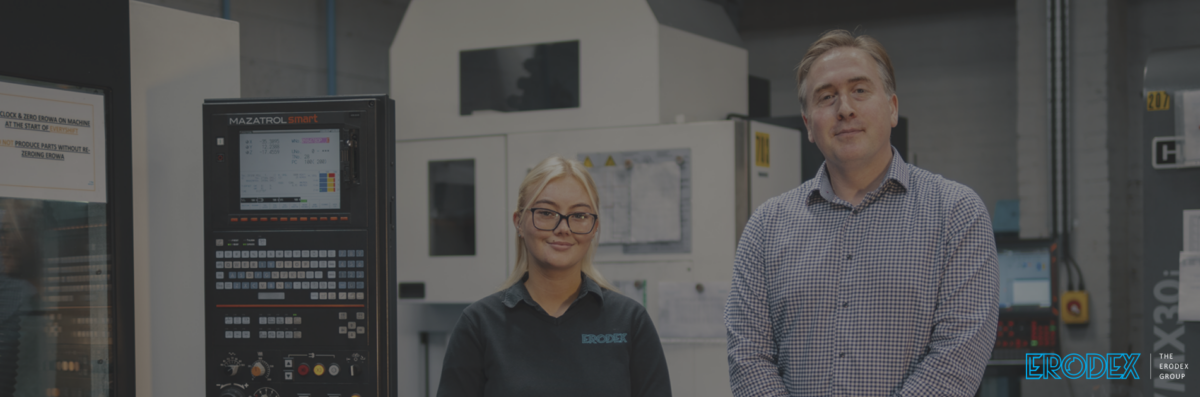
AndyMcFarlane (Erodex - pictured left) and Paul McHugh (ComplexHPE - pictured right)
Categories
Case Study

Continuous improvement positions Aerospace supplier for take-off post pandemic

The UK aerospace sector has experienced unprecedented challenges as a result of the global pandemic, challenges that have affected engineering firms at every level of the supply chain, including market leaders.

Fortunately for one leader in their field, the investment in a continuous improvement programme pre-pandemic has coincided with the requirement for increased efficiencies and reduced cost per part that are now necessitated by an industry battling for recovery.

Such is the success of the programme that it has not only ensured the company is better positioned to weather the current storm but has also created new business opportunities thanks to more competitive processes and the implementation of advanced technology.

James Kirk, Director of Operations at Erodex UK, the UK’s leading supplier of EDM graphite, graphite machining and tooling to the aerospace market, joined the company in 2019 to spearhead the CI drive.

Here, he tells us more about the journey that he has been leading the company on.

“We are in an environment now in aerospace where cost per part is becoming even more critical than it was two years ago” says Kirk.

“More than ever, we are required to find more efficient ways of producing and must therefore embrace a strategic commitment to improvement and change.

This is far easier to do when you are doing it in a business that is not performing. It is much more difficult to come into a business like Erodex, a market leader that was profitable and had been growing year on year and say ‘we need to improve’”.

However, that is what Kirk, working alongside fellow directors and owners Steve, Ian and John Rolinson, set about doing at their Graphite Machining Facility in Wednesbury, West Midlands.

“Initially we set about understanding what the true performance of the facility was. We identified potential to improve delivery adherence and then needed to understand what the drivers were behind that; was it down to performance, capacity, efficiencies, or a combination of these?

“It became quite clear that there was scope to improve workflow and machining efficiencies” continues Kirk.

Focusing on the priority areas of improving the efficiency, aesthetics and workflow of the shop floor, a CI road map was agreed between the Directors that also gave Kirk a wide scope on investment moving forward.

Basic but quick wins closed out in the first year included improving the layout of the factory, de cluttering and implementing cellular environments for grinding and machining. This created a far more lean and efficient production environment that complimented other fundamental improvements such as white boards and daily team meetings.

Kirk adds: “After a period of evaluation, we focused on encouraging our people towards embracing change and wanting to be part of the journey, ensuring that we had the right mindset and philosophy of the people on site.

“We tried to show them that by changing, they will make it both easier for themselves and better for the business. For example, by raising the level of inspection, improving the workflow so material is always ready in advance for the machinist to start their next job, ensuring tooling has been checked. This kind of method in manufacture is very basic, but once bought into these basic principles, it is easier for individuals to go with the greater leaps of faith”.

Driving down costs in existing programs through a ‘one operator, three machines’ philosophy of multitasking and re-assigning roles and responsibilities laid the foundation for investment in new machinery and exploring new processes.

“We’re at the more technical end of the road map now; drilling down part by part into high value runners and repeaters. If you look at what we have done on one of our highest value lines, we have driven in some significant savings into our products. We are now developing new techniques and are now looking at robotics for high volume products”, Kirk continues.

“We’ve started asking new questions, such as ‘how can we take that part that we’ve machined in a 3-axis orientation and machine it in a 5-axis orientation – and what does that do to our cost per part’?”

“Investing in and maximising the capability of different machinery such as 5-axis also opens us up to new products and industries going forward. As a business, I think we’ve began to acknowledge that whilst we are industry leaders at what we do, we can push ourselves to grow into new areas as well and there are aspects of electrode manufacture in Aerospace that we’ve not been able to do for one reason or another in the past, mainly technological reasons”.

The company believes the £1.75m programme of expansion will ensure that it is best placed to capitalise on the expected economic upturn throughout 2021 and beyond.

Investment in new machinery has seen capacity at the site increase by 40 per cent and has enabled the company to secure a contract for a part that they were previously ‘not competitive on’ within the first two weeks of having the new aerospace machine on site.

This is combined with investment in a growing team that are bought into the vision of where Kirk and the Erodex Directors are taking the business.

“We’ve got a team that are really bought in to what we do. We’re investing in our people, progressing young talent within the business and ultimately for me, you get a more proactive response if you have a more dynamic mix of talent within your workforce.

“It is just a case of constantly pushing forward” concludes Kirk.

If you are interested in learning more, please contact us.