Uncategorized Archives - Page 2 of 5 - Erodex
类别
未分类

工业碳刷

工业碳刷:综合指南


In the intricate machinery that powers our modern world, the role of industrial carbon brushes is often overlooked but undeniably crucial. These small yet powerful components play a vital role in various applications, from electric motors to generators, ensuring the smooth transmission of electrical energy. As part of your research into industrial carbon brushes, this comprehensive guide aims to provide accurate, detailed information on their composition, functions, applications, and advancements in this essential field.


I.了解工业碳刷的基本知识

1.1 组成和结构

Industrial carbon brushes are typically composed of carbon and other materials that enhance their conductivity, durability, and friction properties. The primary component, carbon, is chosen for its excellent electrical conductivity and wear resistance. Other materials, such as metal powders and binders, are often added to the carbon mix to improve the brush’s mechanical strength and overall performance.

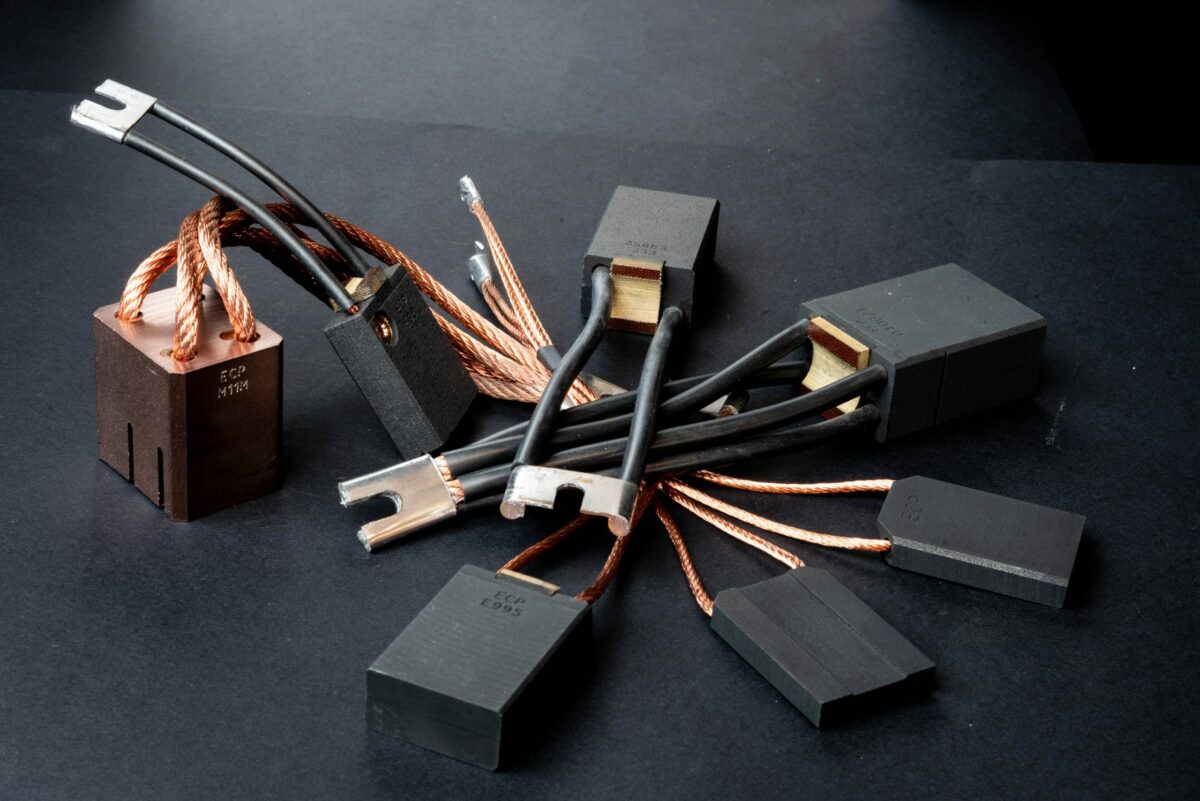
The structure of a carbon brush can vary depending on its intended application. In general, a basic carbon brush consists of a carbon block, a metal shunt, and a connection terminal. The carbon block is the primary contact surface, responsible for conducting electricity and transferring it to the machinery’s rotating part.

1.2 工作原理

The fundamental principle behind industrial carbon brushes lies in their ability to establish and maintain electrical contact with the rotating part of a machine, such as a rotor or commutator in an electric motor. As the machine operates, the carbon brush slides against the rotating surface, creating a conductive path for the electrical current.

碳刷与旋转部件之间的摩擦力经过精心平衡,以确保有效的电气接触,同时不会造成过度磨损。这种微妙的平衡对于碳刷及其所服务机械的寿命和效率至关重要。


II.工业碳刷的应用

2.1 电机

One of the primary applications of industrial carbon brushes is in electric motors. In DC (direct current) motors, carbon brushes are essential components that transfer electrical energy from the stationary part (stator) to the rotating part (rotor). The brushes maintain continuous contact with the commutator, ensuring a constant current flow and enabling the motor to operate smoothly.

In AC (alternating current) motors, carbon brushes are less common because the design often uses other methods to transfer electrical energy. However, in certain specialised applications, such as high-performance AC motors, carbon brushes may still be employed to achieve optimal performance.

2.2 发电机

工业碳刷在发电机中也起着至关重要的作用,其功能与在电动机中的作用类似。碳刷与发电机的旋转部分保持接触,从而将机械能转化为电能。这一过程是发电厂和各种工业环境发电的基础。

2.3 风力涡轮机

As the demand for renewable energy sources grows, so does the importance of industrial carbon brushes in wind turbines. These brushes are used in the turbine’s generator system to ensure efficient power generation from the wind’s kinetic energy. The reliability and longevity of carbon brushes are particularly crucial in this application, given the often remote and challenging environments where wind turbines are installed.

2.4 工业机械

除了电动机和发电机,工业碳刷还广泛应用于各种机械,包括输送系统、起重机和电动工具。碳刷能够在旋转系统中提供可靠的电气连接,因此在需要将电能传输到运动部件的场合中是不可或缺的。


III.影响工业碳刷性能的因素

影响工业碳刷性能的因素

3.1 材料选择

The choice of materials for manufacturing industrial carbon brushes significantly influences their performance and longevity. Different grades of carbon, along with additives such as metal powders and binders, are used. They are carefully selected based on the specific requirements of the application. The goal is to achieve a balance between electrical conductivity, wear resistance, and mechanical strength.

3.2 刷子设计

碳刷的设计因机械类型及其运行条件而异。碳刷尺寸、形状和碳块排列等因素都会影响碳刷保持有效电气接触的能力。工程师和制造商精心设计碳刷,以确保最佳性能,同时最大限度地减少磨损和摩擦。

3.3 运行条件

The operating conditions of a particular application significantly affect the performance of industrial carbon brushes. Factors such as temperature, humidity, and the presence of contaminants can influence the wear rate and electrical conductivity of the brushes. In extreme environments. Specialised carbon brushes with enhanced resistance to harsh conditions may be required.


IV.工业碳刷技术的进步

工业碳刷技术的进步

4.1 先进材料

Recent advancements in material science have led to the development of high-performance carbon brush materials. Carbon composites, carbon-graphite blends, and hybrid materials incorporating metal nanoparticles are examples of innovations aimed at improving conductivity, wear resistance, and overall brush performance. These advanced materials contribute to longer service life and increased efficiency in various industrial applications.

4.2 智能碳刷

在工业碳刷中集成传感器技术是一种新兴趋势,有可能彻底改变预测性维护策略。配备传感器的智能碳刷可提供有关碳刷磨损、温度和振动等因素的实时数据。利用这些数据可以进行主动维护,减少停机时间,优化碳刷及其服务设备的使用寿命。

4.3 可持续碳刷

为了响应对可持续发展的日益重视。开发对环境影响更小的碳刷的兴趣日益高涨。制造商们正在探索环保材料和生产工艺。旨在生产出不仅高效而且对环境负责的碳刷。这一转变与可持续发展和负责任的生产实践这一更广泛的行业趋势相一致。


V.挑战和未来展望

5.1 碳刷技术面临的挑战

Despite their critical role in industrial machinery, carbon brushes are not without challenges. Wear and tear over time, and the need for periodic replacement. The potential for brush sparking is an issue that engineers and researchers continually address. Finding solutions to these challenges involves a combination of material advancements, innovative design approaches, and ongoing research into the optimal operating conditions for carbon brushes.

5.2 未来发展

Looking ahead, the future of industrial carbon brushes is likely to involve further integration of digital technologies. This will involve continued material advancements and a focus on sustainability. The ongoing quest for longer service life, improved performance, and reduced environmental impact will drive innovation in this field. Additionally, collaborations among researchers, manufacturers, and end users will play a crucial role. This role will shape the next generation of carbon brush technology.

In conclusion, industrial carbon brushes are unassuming yet indispensable components that power a wide array of machinery essential to our daily lives. They power everything from electric motors and generators to wind turbines and industrial machinery. The reliable transmission of electrical energy relies on the efficiency and durability of these small yet crucial components as technology advances and industries evolve. Research and development in industrial carbon brushes continue to pave the way for more efficient, sustainable, and technologically advanced solutions by delving into the intricacies of their composition, working principles, applications, influencing factors, and recent advancements. This comprehensive guide aims to provide you with the knowledge needed to navigate the fascinating world of industrial carbon brushes.
类别
未分类

Carbon Brushes: Composition and Function


通过 Erodex 了解碳刷的成分和功能


Carbon brushes play a pivotal role in the smooth operation of various electrical machines, serving as critical components that facilitate the transfer of electrical current between stationary and rotating parts. In this article, we will delve into the composition and function of carbon brushes, shedding light on their crucial role in ensuring the efficiency and longevity of electrical systems.

碳刷的成分

Carbon brushes are primarily composed of carbon and other materials carefully chosen to meet specific performance requirements. The main component, carbon, is selected for its unique properties, which make it an ideal material for electrical contact applications. The carbon used in brushes is typically graphite, which offers low electrical resistance, excellent conductivity, and self-lubricating properties.


To enhance the performance of carbon brushes, manufacturers often incorporate other materials into the composition. Metals such as copper, silver, or alloys may be added to improve conductivity and heat dissipation. Additionally, binders and fillers are used to give the brushes mechanical strength and stability. The careful balance of these elements results in a carbon brush with optimal electrical and mechanical properties.


碳刷的功能

The primary function of carbon brushes is to establish and maintain electrical contact between the stationary and rotating parts of electrical machines, such as motors and generators. As electrical current flows through the brushes, it is transmitted to the rotating component, thereby converting electrical energy into mechanical motion. Conversely, in generators, the brushes collect the electrical energy generated by the machine’s rotation.


碳刷的一个重要方面是能够承受电机内的苛刻条件。这些电刷的工作环境温度高、负载变化大,有时还会有腐蚀性气体。碳刷的成分必须能够承受这些条件,同时保持稳定的性能。


磨损:

碳刷在运行过程中会出现磨损,这是摩擦和电接触的自然结果。磨损率取决于负载、速度和碳刷运行环境等因素。为此,制造商设计了具有特定磨损特性的碳刷,以确保可预测的使用寿命,并将意外故障的风险降至最低。


定期维护,包括监测电刷磨损情况并在必要时更换电刷,对电机的可靠运行至关重要。忽视这一点会导致电阻增加、效率降低,甚至损坏机器部件。


选择合适的碳刷

Selecting the appropriate carbon brush for a specific application requires careful consideration of various factors. Electrical engineers and maintenance professionals must assess the machine’s operating conditions, including voltage, current, speed, and environmental factors. Additionally, understanding the requirements for brush life and performance is essential to choosing the right brush composition and design.

In conclusion, carbon brushes are integral components in the functionality of electrical machines, ensuring the efficient transfer of electrical energy between stationary and rotating parts. Their composition, predominantly carbon with carefully selected additives, gives them the electrical and mechanical properties necessary for optimal performance. Regular maintenance and a thoughtful selection process are key to maximising the lifespan and reliability of carbon brushes, ultimately contributing to the longevity and efficiency of electrical systems. As technology advances, the evolution of carbon brush materials and designs will continue, further enhancing their performance in a wide range of applications.

类别
未分类

线切割:工作原理与应用

线切割:工作原理与应用

导言


In the ever-evolving landscape of modern manufacturing, precision and efficiency are paramount. As industries demand higher tolerances and intricate designs, traditional machining methods often fall short. This is where Wire Electrical Discharge Machining (EDM) steps in as a revolutionary process, offering unparalleled precision and versatility. In this comprehensive article, we will delve into the intricacies of Wire EDM cutting, exploring its principles, mechanics, and a myriad of applications that make it an indispensable tool in the manufacturing arsenal.


了解基础知识


Wire EDM, also known as wire-cut EDM, wire cutting, or just EDM, is a non-traditional machining process that uses a thin, electrically charged wire to precisely cut through conductive materials. The method is based on the principles of electrical discharge machining, a process that utilises electrical sparks to erode material.


1.设置


The core of a Wire EDM machine consists of a workpiece, typically made of metals like aluminium, steel, or titanium, and a spool of electrically conductive wire, usually made of brass or coated with a thin layer of brass. The workpiece and wire are submerged in a dielectric fluid, often deionised water, to facilitate the process and flush away debris.


2.放电


The wire is systematically fed through the workpiece, guided by computer numerical control (CNC) systems. When the wire approaches the workpiece, an electric potential difference is applied, causing sparks (electrical discharges) to form between the wire and the workpiece. These sparks generate intense heat, melting and vaporising material in their path.


3.材料清除


As the material is vaporised, the wire continues its path, leaving a narrow cut, or kerf, in the workpiece. The precision of Wire EDM is unparalleled, with kerf widths as small as 0.02 mm possible. This method allows for intricate shapes and fine details that traditional machining processes struggle to achieve.

线切割加工背后的机械原理


要充分了解线切割加工的能力,关键是要了解驱动该工艺的机械原理。


1.热侵蚀


The key to Wire EDM lies in controlled thermal erosion. The intense heat generated during the electrical discharges causes the material to reach its melting point, after which it subsequently vaporises. Unlike traditional machining, where physical forces remove material, Wire EDM relies on the thermal energy of sparks to achieve the desired results.


2.数控精度


The precision of Wire EDM is largely attributed to the integration of Computer Numerical Control (CNC) systems. These systems guide the wire with meticulous accuracy, ensuring that the desired pattern is followed with minimal deviation. CNC programming enables complex designs to be replicated consistently, making Wire EDM ideal for applications requiring high precision.


线切割的应用


1.航空航天工业


The aerospace industry demands components with exceptional precision and durability. Wire EDM’s ability to cut through tough materials like titanium and nickel alloys with minimal heat-affected zones makes it indispensable for manufacturing critical aerospace components, such as turbine blades, engine components, and intricate parts for spacecraft.


2.医疗设备制造


In the field of medical device manufacturing, where precision is a matter of life and death, Wire EDM shines. The process is commonly used to produce intricate components for medical devices, including surgical instruments, orthopaedic implants, and components for diagnostic equipment. The fine detail achievable with Wire EDM ensures that medical devices meet stringent quality standards.


3.汽车行业


In the automotive industry, where the push for lightweight materials and intricate designs is constant, Wire EDM plays a vital role. From producing precision gears and transmission components to crafting complex moulds for plastic injection moulding, Wire EDM offers the accuracy and repeatability required to meet the stringent standards of automotive manufacturing.


4.电子学和微电子学


电子元件的尺寸不断缩小,这就要求制造工艺能够与时俱进。线切割放电加工能以微米级的精度切割复杂的形状,因此是生产电子和微电子领域所用小型复杂零件的理想选择。从连接器到传感器,线切割加工都能生产出符合现代电子设备高标准的部件。


5.工具和模具制造


Tool and die making is a cornerstone of manufacturing across various industries. Wire EDM’s ability to cut complex shapes, sharp angles, and intricate contours makes it a preferred method for producing moulds, dies, and tooling. The process’s precision ensures that the manufactured tools meet the required specifications, resulting in higher quality and efficiency in production processes.


6.原型设计和小批量生产


线切割机床的多功能性还体现在原型设计和小批量生产方面。快速准确地生产原型的能力使制造商能够在投入大规模生产之前测试和完善设计。此外,对于小批量生产,线切割加工还提供了一种具有成本效益的解决方案,只需最短的设置时间。


线切割放电加工的优势


1.高精度


Wire EDM’s primary advantage lies in its unmatched precision. The process can achieve tolerances in the range of micrometres, ensuring that components consistently meet exact specifications.


2.尽量减少材料浪费


Unlike traditional machining methods that remove material through physical forces, Wire EDM’s thermal erosion minimises material waste. The process is highly efficient, making it a cost-effective choice for applications where materials are expensive or scarce.


3.复杂几何


Wire EDM excels in cutting complex geometries that would be challenging or impossible to achieve with traditional machining methods. The process allows for the creation of intricate shapes and fine details with ease.


4.最小热影响区


Since Wire EDM relies on thermal erosion rather than physical forces, the heat-affected zone (HAZ) is minimal. This is crucial for materials with sensitive properties or for applications that require tight tolerances.


5.多功能性


线切割放电加工用途广泛,可应用于多种材料,包括导电金属和合金。这种多功能性使其适用于各种行业和应用。


挑战和考虑因素


While Wire EDM offers numerous advantages, it is essential to consider the challenges associated with the process.


1.材料导电性


线切割加工对导电材料最为有效。非导电材料,如陶瓷或某些复合材料,则不适合这种加工方法。制造商在选择合适的加工方法时必须考虑材料的特性。


2.表面处理


线切割放电加工的表面光洁度一般都很好,但某些因素(如使用的介电流体类型和线材状况)会影响最终效果。为达到特定的表面光洁度,可能需要进行后处理。


3.断线


Wire breakage is a potential issue in Wire EDM. Factors such as wire tension, electrical discharge conditions, and workpiece geometry can contribute to wire breakage. Proper machine setup and maintenance are crucial to minimising risk.


4.成本因素


虽然线切割放电加工具有高精度,但它并不总是每种应用中最具成本效益的选择。制造商必须权衡材料成本、产量和装调时间等因素,以确定最适合特定项目的加工方法。


结论


Wire EDM cutting has emerged as a cornerstone technology in modern manufacturing, offering unparalleled precision and versatility. Its applications span industries that demand intricate designs and high tolerances, from aerospace to medical device manufacturing. The method’s reliance on thermal erosion, guided by advanced CNC systems, sets it apart from traditional machining methods, opening up new possibilities for engineers and designers.


As technology continues to advance, Wire EDM is likely to evolve further, pushing the boundaries of what is achievable in precision and efficiency as manufacturers strive to meet the ever-increasing demands for complex components and streamlined production processes. Wire EDM stands as a testament to innovation in machining.