Uncategorized Archives - Seite 2 von 5 - Erodex
Kategorien
Uncategorized

Industrielle Kohlebürsten

Industrielle Kohlebürsten: Ein umfassender Leitfaden


In the intricate machinery that powers our modern world, the role of industrial carbon brushes is often overlooked but undeniably crucial. These small yet powerful components play a vital role in various applications, from electric motors to generators, ensuring the smooth transmission of electrical energy. As part of your research into industrial carbon brushes, this comprehensive guide aims to provide accurate, detailed information on their composition, functions, applications, and advancements in this essential field.


I. Die Grundlagen der industriellen Kohlebürsten

1.1 Zusammensetzung und Struktur

Industrial carbon brushes are typically composed of carbon and other materials that enhance their conductivity, durability, and friction properties. The primary component, carbon, is chosen for its excellent electrical conductivity and wear resistance. Other materials, such as metal powders and binders, are often added to the carbon mix to improve the brush’s mechanical strength and overall performance.

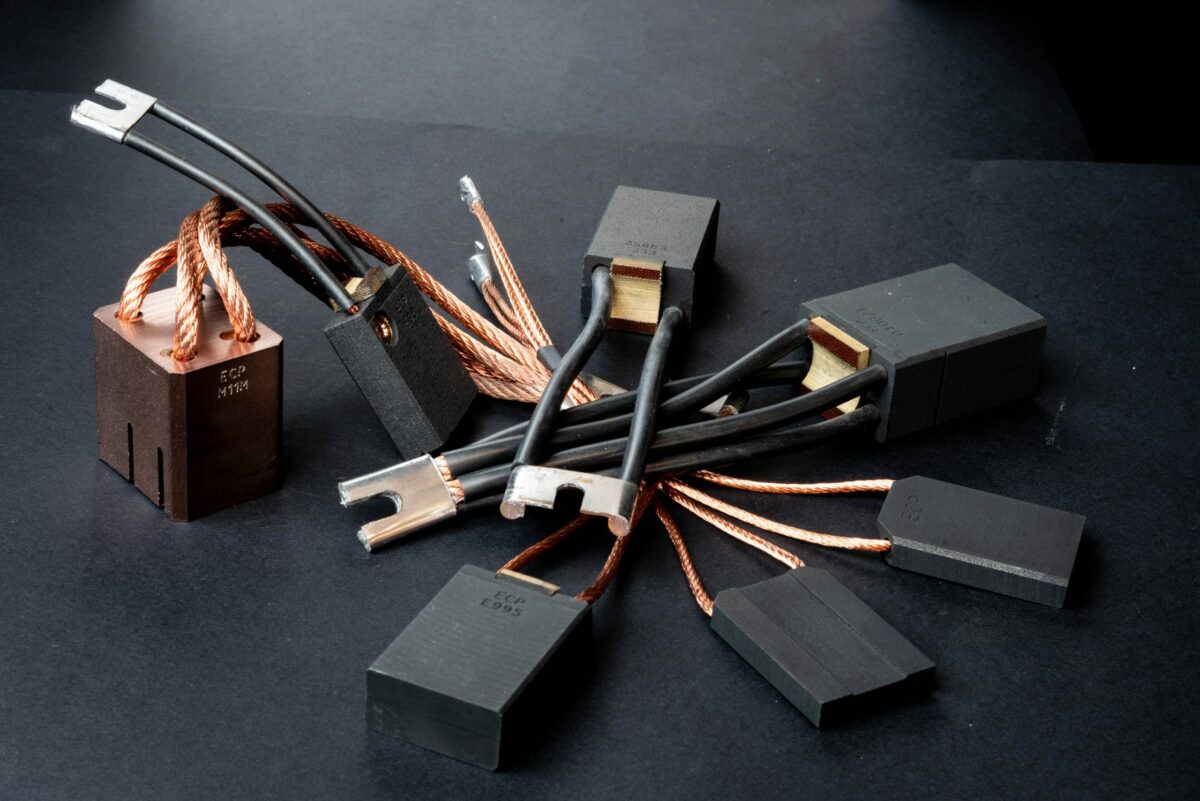
The structure of a carbon brush can vary depending on its intended application. In general, a basic carbon brush consists of a carbon block, a metal shunt, and a connection terminal. The carbon block is the primary contact surface, responsible for conducting electricity and transferring it to the machinery’s rotating part.

1.2 Arbeitsprinzip

The fundamental principle behind industrial carbon brushes lies in their ability to establish and maintain electrical contact with the rotating part of a machine, such as a rotor or commutator in an electric motor. As the machine operates, the carbon brush slides against the rotating surface, creating a conductive path for the electrical current.

Die Reibung zwischen der Kohlebürste und dem rotierenden Bauteil wird sorgfältig ausbalanciert, um einen effektiven elektrischen Kontakt zu gewährleisten, ohne übermäßigen Verschleiß zu verursachen. Dieses empfindliche Gleichgewicht ist entscheidend für die Langlebigkeit und Effizienz sowohl der Bürste als auch der Maschine, die sie bedient.


II. Anwendungen von Industriekohlebürsten

2.1 Elektromotoren

One of the primary applications of industrial carbon brushes is in electric motors. In DC (direct current) motors, carbon brushes are essential components that transfer electrical energy from the stationary part (stator) to the rotating part (rotor). The brushes maintain continuous contact with the commutator, ensuring a constant current flow and enabling the motor to operate smoothly.

In AC (alternating current) motors, carbon brushes are less common because the design often uses other methods to transfer electrical energy. However, in certain specialised applications, such as high-performance AC motors, carbon brushes may still be employed to achieve optimal performance.

2.2 Generatoren

Industriekohlebürsten spielen auch in Generatoren eine wichtige Rolle, wo sie eine ähnliche Funktion wie in Elektromotoren haben. Die Bürsten halten den Kontakt mit dem rotierenden Teil des Generators aufrecht und ermöglichen so die Umwandlung von mechanischer Energie in elektrische Energie. Dieser Prozess ist von grundlegender Bedeutung für die Stromerzeugung in Kraftwerken und verschiedenen industriellen Bereichen.

2.3 Windturbinen

As the demand for renewable energy sources grows, so does the importance of industrial carbon brushes in wind turbines. These brushes are used in the turbine’s generator system to ensure efficient power generation from the wind’s kinetic energy. The reliability and longevity of carbon brushes are particularly crucial in this application, given the often remote and challenging environments where wind turbines are installed.

2.4 Industrielle Maschinen

Neben Elektromotoren und Generatoren werden Industriekohlebürsten in einer Vielzahl von Maschinen eingesetzt, darunter Förderanlagen, Kräne und Elektrowerkzeuge. Ihre Fähigkeit, eine zuverlässige elektrische Verbindung in rotierenden Systemen herzustellen, macht sie in Szenarien unverzichtbar, in denen elektrische Energie auf sich bewegende Komponenten übertragen werden muss.


III. Faktoren, die die Leistung von Industriekohlebürsten beeinflussen

Faktoren, die die Leistung von industriellen Kohlebürsten beeinflussen

3.1 Materialauswahl

The choice of materials for manufacturing industrial carbon brushes significantly influences their performance and longevity. Different grades of carbon, along with additives such as metal powders and binders, are used. They are carefully selected based on the specific requirements of the application. The goal is to achieve a balance between electrical conductivity, wear resistance, and mechanical strength.

3.2 Bürstendesign

Die Konstruktion von Kohlebürsten hängt von der Art der Maschine und ihren Betriebsbedingungen ab. Faktoren wie die Bürstengröße, die Form und die Anordnung der Kohleblöcke können sich auf die Fähigkeit der Bürste auswirken, einen effektiven elektrischen Kontakt aufrechtzuerhalten. Ingenieure und Hersteller konstruieren Kohlebürsten sorgfältig, um eine optimale Leistung bei gleichzeitiger Minimierung von Verschleiß und Reibung zu gewährleisten.

3.3 Betriebsbedingungen

The operating conditions of a particular application significantly affect the performance of industrial carbon brushes. Factors such as temperature, humidity, and the presence of contaminants can influence the wear rate and electrical conductivity of the brushes. In extreme environments. Specialised carbon brushes with enhanced resistance to harsh conditions may be required.


IV. Fortschritte in der industriellen Kohlebürstentechnologie

Fortschritte in der industriellen Kohlebürstentechnologie

4.1 Fortgeschrittene Materialien

Recent advancements in material science have led to the development of high-performance carbon brush materials. Carbon composites, carbon-graphite blends, and hybrid materials incorporating metal nanoparticles are examples of innovations aimed at improving conductivity, wear resistance, and overall brush performance. These advanced materials contribute to longer service life and increased efficiency in various industrial applications.

4.2 Intelligente Kohlebürsten

Die Integration von Sensortechnologien in industrielle Kohlebürsten ist ein aufkommender Trend, der das Potenzial hat, vorausschauende Wartungsstrategien zu revolutionieren. Mit Sensoren ausgestattete intelligente Kohlebürsten können Echtzeitdaten zu Faktoren wie Bürstenverschleiß, Temperatur und Vibration liefern. Diese Daten ermöglichen eine proaktive Wartung, die Ausfallzeiten reduziert und die Lebensdauer sowohl der Bürsten als auch der Maschinen, die sie bedienen, optimiert.

4.3 Nachhaltige Kohlebürsten

Als Reaktion auf die wachsende Bedeutung der Nachhaltigkeit. Das Interesse an der Entwicklung von Kohlebürsten mit geringeren Umweltauswirkungen steigt. Die Hersteller erforschen umweltfreundliche Materialien und Produktionsverfahren. Ziel ist es, Bürsten zu entwickeln, die nicht nur effizient, sondern auch umweltverträglich sind. Diese Entwicklung entspricht dem allgemeinen Trend in der Branche hin zu nachhaltigen und verantwortungsbewussten Herstellungspraktiken.


V. Herausforderungen und Zukunftsaussichten

5.1 Herausforderungen in der Kohlebürstentechnologie

Despite their critical role in industrial machinery, carbon brushes are not without challenges. Wear and tear over time, and the need for periodic replacement. The potential for brush sparking is an issue that engineers and researchers continually address. Finding solutions to these challenges involves a combination of material advancements, innovative design approaches, and ongoing research into the optimal operating conditions for carbon brushes.

5.2 Künftige Entwicklungen

Looking ahead, the future of industrial carbon brushes is likely to involve further integration of digital technologies. This will involve continued material advancements and a focus on sustainability. The ongoing quest for longer service life, improved performance, and reduced environmental impact will drive innovation in this field. Additionally, collaborations among researchers, manufacturers, and end users will play a crucial role. This role will shape the next generation of carbon brush technology.

In conclusion, industrial carbon brushes are unassuming yet indispensable components that power a wide array of machinery essential to our daily lives. They power everything from electric motors and generators to wind turbines and industrial machinery. The reliable transmission of electrical energy relies on the efficiency and durability of these small yet crucial components as technology advances and industries evolve. Research and development in industrial carbon brushes continue to pave the way for more efficient, sustainable, and technologically advanced solutions by delving into the intricacies of their composition, working principles, applications, influencing factors, and recent advancements. This comprehensive guide aims to provide you with the knowledge needed to navigate the fascinating world of industrial carbon brushes.
Kategorien
Uncategorized

Carbon Brushes: Composition and Function


Verständnis der Zusammensetzung und Funktion von Kohlebürsten durch Erodex


Carbon brushes play a pivotal role in the smooth operation of various electrical machines, serving as critical components that facilitate the transfer of electrical current between stationary and rotating parts. In this article, we will delve into the composition and function of carbon brushes, shedding light on their crucial role in ensuring the efficiency and longevity of electrical systems.

Zusammensetzung der Kohlebürsten:

Carbon brushes are primarily composed of carbon and other materials carefully chosen to meet specific performance requirements. The main component, carbon, is selected for its unique properties, which make it an ideal material for electrical contact applications. The carbon used in brushes is typically graphite, which offers low electrical resistance, excellent conductivity, and self-lubricating properties.


To enhance the performance of carbon brushes, manufacturers often incorporate other materials into the composition. Metals such as copper, silver, or alloys may be added to improve conductivity and heat dissipation. Additionally, binders and fillers are used to give the brushes mechanical strength and stability. The careful balance of these elements results in a carbon brush with optimal electrical and mechanical properties.


Funktion der Kohlebürsten:

The primary function of carbon brushes is to establish and maintain electrical contact between the stationary and rotating parts of electrical machines, such as motors and generators. As electrical current flows through the brushes, it is transmitted to the rotating component, thereby converting electrical energy into mechanical motion. Conversely, in generators, the brushes collect the electrical energy generated by the machine’s rotation.


Ein wichtiger Aspekt von Kohlebürsten ist ihre Fähigkeit, den anspruchsvollen Bedingungen in elektrischen Maschinen standzuhalten. Diese Bürsten arbeiten in Umgebungen mit hohen Temperaturen, wechselnden Lasten und manchmal aggressiven Atmosphären. Die Zusammensetzung der Bürsten muss so beschaffen sein, dass sie diesen Bedingungen standhält und gleichzeitig eine gleichbleibende Leistung bietet.


Abnutzung und Verschleiß:

Kohlebürsten unterliegen während des Betriebs einem Verschleiß, eine natürliche Folge der Reibung und des elektrischen Kontakts, den sie ermöglichen. Die Verschleißrate hängt von Faktoren wie Belastung, Geschwindigkeit und der Umgebung ab, in der die Bürsten arbeiten. Um diesem Umstand Rechnung zu tragen, entwickeln die Hersteller Bürsten mit spezifischen Abnutzungseigenschaften, um eine vorhersehbare Lebensdauer zu gewährleisten und das Risiko unerwarteter Ausfälle zu minimieren.


Die regelmäßige Wartung, einschließlich der Überwachung des Bürstenverschleißes und des erforderlichen Austauschs, ist für den zuverlässigen Betrieb elektrischer Maschinen entscheidend. Eine Vernachlässigung dieses Aspekts kann zu erhöhtem elektrischem Widerstand, verringerter Effizienz und sogar zu Schäden an den Maschinenkomponenten führen.


Die Wahl der richtigen Kohlebürste:

Selecting the appropriate carbon brush for a specific application requires careful consideration of various factors. Electrical engineers and maintenance professionals must assess the machine’s operating conditions, including voltage, current, speed, and environmental factors. Additionally, understanding the requirements for brush life and performance is essential to choosing the right brush composition and design.

In conclusion, carbon brushes are integral components in the functionality of electrical machines, ensuring the efficient transfer of electrical energy between stationary and rotating parts. Their composition, predominantly carbon with carefully selected additives, gives them the electrical and mechanical properties necessary for optimal performance. Regular maintenance and a thoughtful selection process are key to maximising the lifespan and reliability of carbon brushes, ultimately contributing to the longevity and efficiency of electrical systems. As technology advances, the evolution of carbon brush materials and designs will continue, further enhancing their performance in a wide range of applications.

Kategorien
Uncategorized

Drahterodieren: Funktionsweise und Anwendungen

Drahterodieren: Funktionsweise und Anwendungen

Einführung


In the ever-evolving landscape of modern manufacturing, precision and efficiency are paramount. As industries demand higher tolerances and intricate designs, traditional machining methods often fall short. This is where Wire Electrical Discharge Machining (EDM) steps in as a revolutionary process, offering unparalleled precision and versatility. In this comprehensive article, we will delve into the intricacies of Wire EDM cutting, exploring its principles, mechanics, and a myriad of applications that make it an indispensable tool in the manufacturing arsenal.


Verstehen der Grundlagen


Wire EDM, also known as wire-cut EDM, wire cutting, or just EDM, is a non-traditional machining process that uses a thin, electrically charged wire to precisely cut through conductive materials. The method is based on the principles of electrical discharge machining, a process that utilises electrical sparks to erode material.


1. Die Einrichtung


The core of a Wire EDM machine consists of a workpiece, typically made of metals like aluminium, steel, or titanium, and a spool of electrically conductive wire, usually made of brass or coated with a thin layer of brass. The workpiece and wire are submerged in a dielectric fluid, often deionised water, to facilitate the process and flush away debris.


2. Elektrische Entladung


The wire is systematically fed through the workpiece, guided by computer numerical control (CNC) systems. When the wire approaches the workpiece, an electric potential difference is applied, causing sparks (electrical discharges) to form between the wire and the workpiece. These sparks generate intense heat, melting and vaporising material in their path.


3. Materialabtrag


As the material is vaporised, the wire continues its path, leaving a narrow cut, or kerf, in the workpiece. The precision of Wire EDM is unparalleled, with kerf widths as small as 0.02 mm possible. This method allows for intricate shapes and fine details that traditional machining processes struggle to achieve.

Mechanik des Drahterodierens


Um die Möglichkeiten des Drahterodierens voll ausschöpfen zu können, ist es wichtig, die Mechanik des Prozesses zu verstehen.


1. Thermische Erosion


The key to Wire EDM lies in controlled thermal erosion. The intense heat generated during the electrical discharges causes the material to reach its melting point, after which it subsequently vaporises. Unlike traditional machining, where physical forces remove material, Wire EDM relies on the thermal energy of sparks to achieve the desired results.


2. CNC Präzision


The precision of Wire EDM is largely attributed to the integration of Computer Numerical Control (CNC) systems. These systems guide the wire with meticulous accuracy, ensuring that the desired pattern is followed with minimal deviation. CNC programming enables complex designs to be replicated consistently, making Wire EDM ideal for applications requiring high precision.


Anwendungen des Drahterodierens


1. Luft- und Raumfahrtindustrie


The aerospace industry demands components with exceptional precision and durability. Wire EDM’s ability to cut through tough materials like titanium and nickel alloys with minimal heat-affected zones makes it indispensable for manufacturing critical aerospace components, such as turbine blades, engine components, and intricate parts for spacecraft.


2. Herstellung medizinischer Geräte


In the field of medical device manufacturing, where precision is a matter of life and death, Wire EDM shines. The process is commonly used to produce intricate components for medical devices, including surgical instruments, orthopaedic implants, and components for diagnostic equipment. The fine detail achievable with Wire EDM ensures that medical devices meet stringent quality standards.


3. Automobilsektor


In the automotive industry, where the push for lightweight materials and intricate designs is constant, Wire EDM plays a vital role. From producing precision gears and transmission components to crafting complex moulds for plastic injection moulding, Wire EDM offers the accuracy and repeatability required to meet the stringent standards of automotive manufacturing.


4. Elektronik und Mikroelektronik


Die immer kleiner werdenden Dimensionen elektronischer Bauteile erfordern Fertigungsverfahren, die damit Schritt halten können. Die Fähigkeit des Drahterodierens, komplizierte Formen mit mikrometergenauer Präzision zu schneiden, macht es zur idealen Wahl für die Herstellung kleiner, komplizierter Teile, die in der Elektronik und Mikroelektronik verwendet werden. Von Steckern bis hin zu Sensoren ermöglicht das Drahterodieren die Herstellung von Komponenten, die den hohen Anforderungen moderner elektronischer Geräte entsprechen.


5. Werkzeug- und Formenbau


Tool and die making is a cornerstone of manufacturing across various industries. Wire EDM’s ability to cut complex shapes, sharp angles, and intricate contours makes it a preferred method for producing moulds, dies, and tooling. The process’s precision ensures that the manufactured tools meet the required specifications, resulting in higher quality and efficiency in production processes.


6. Prototyping und Kleinserienfertigung


Die Vielseitigkeit der Drahterosion erstreckt sich auch auf die Herstellung von Prototypen und Kleinserien. Die Möglichkeit, schnell und präzise Prototypen herzustellen, erlaubt es den Herstellern, ihre Entwürfe zu testen und zu verfeinern, bevor sie sich für eine Großserienproduktion entscheiden. Darüber hinaus bietet das Drahterodieren für Kleinserien eine kostengünstige Lösung mit minimaler Einrichtungszeit.


Vorteile des Drahterodierens


1. Hohe Präzision


Wire EDM’s primary advantage lies in its unmatched precision. The process can achieve tolerances in the range of micrometres, ensuring that components consistently meet exact specifications.


2. Minimaler Materialabfall


Unlike traditional machining methods that remove material through physical forces, Wire EDM’s thermal erosion minimises material waste. The process is highly efficient, making it a cost-effective choice for applications where materials are expensive or scarce.


3. Komplexe Geometrie


Wire EDM excels in cutting complex geometries that would be challenging or impossible to achieve with traditional machining methods. The process allows for the creation of intricate shapes and fine details with ease.


4. Minimale hitzebeeinflusste Zone


Since Wire EDM relies on thermal erosion rather than physical forces, the heat-affected zone (HAZ) is minimal. This is crucial for materials with sensitive properties or for applications that require tight tolerances.


5. Vielseitigkeit


Drahterodieren ist ein vielseitiges Verfahren, das für eine breite Palette von Materialien, einschließlich leitfähiger Metalle und Legierungen, eingesetzt werden kann. Diese Vielseitigkeit macht es für verschiedene Branchen und Anwendungen geeignet.


Herausforderungen und Überlegungen


While Wire EDM offers numerous advantages, it is essential to consider the challenges associated with the process.


1. Leitfähigkeit des Materials


Drahterodieren ist am effektivsten bei leitenden Materialien. Nicht leitende Materialien wie Keramik oder bestimmte Verbundwerkstoffe sind für dieses Verfahren nicht geeignet. Die Hersteller müssen bei der Auswahl der geeigneten Bearbeitungsmethode die Materialeigenschaften berücksichtigen.


2. Oberflächengüte


Die mit dem Drahterodieren erzielte Oberflächengüte ist im Allgemeinen hervorragend, aber bestimmte Faktoren, wie die Art der verwendeten dielektrischen Flüssigkeit und der Zustand des Drahtes, können das Endergebnis beeinflussen. Um bestimmte Oberflächengüten zu erzielen, kann eine Nachbearbeitung erforderlich sein.


3. Drahtbruch


Wire breakage is a potential issue in Wire EDM. Factors such as wire tension, electrical discharge conditions, and workpiece geometry can contribute to wire breakage. Proper machine setup and maintenance are crucial to minimising risk.


4. Kostenerwägungen


Obwohl das Drahterodieren eine hohe Präzision bietet, ist es nicht immer die kostengünstigste Option für jede Anwendung. Hersteller müssen Faktoren wie Materialkosten, Produktionsvolumen und Einrichtungszeit abwägen, um die am besten geeignete Bearbeitungsmethode für ein bestimmtes Projekt zu bestimmen.


Schlussfolgerung


Wire EDM cutting has emerged as a cornerstone technology in modern manufacturing, offering unparalleled precision and versatility. Its applications span industries that demand intricate designs and high tolerances, from aerospace to medical device manufacturing. The method’s reliance on thermal erosion, guided by advanced CNC systems, sets it apart from traditional machining methods, opening up new possibilities for engineers and designers.


As technology continues to advance, Wire EDM is likely to evolve further, pushing the boundaries of what is achievable in precision and efficiency as manufacturers strive to meet the ever-increasing demands for complex components and streamlined production processes. Wire EDM stands as a testament to innovation in machining.