Uncategorized Archives - Page 2 of 5 - Erodex
Catégories
Non classé

Brosses en carbone industrielles

Industrial Carbon Brushes: A Comprehensive Guide


In the intricate machinery that powers our modern world, the role of industrial carbon brushes is often overlooked but undeniably crucial. These small yet powerful components play a vital role in various applications, from electric motors to generators, ensuring the smooth transmission of electrical energy. As part of your research into industrial carbon brushes, this comprehensive guide aims to provide accurate, detailed information on their composition, functions, applications, and advancements in this essential field.


I. Understanding the Basics of Industrial Carbon Brushes

1.1 Composition and Structure

Industrial carbon brushes are typically composed of carbon and other materials that enhance their conductivity, durability, and friction properties. The primary component, carbon, is chosen for its excellent electrical conductivity and wear resistance. Other materials, such as metal powders and binders, are often added to the carbon mix to improve the brush’s mechanical strength and overall performance.

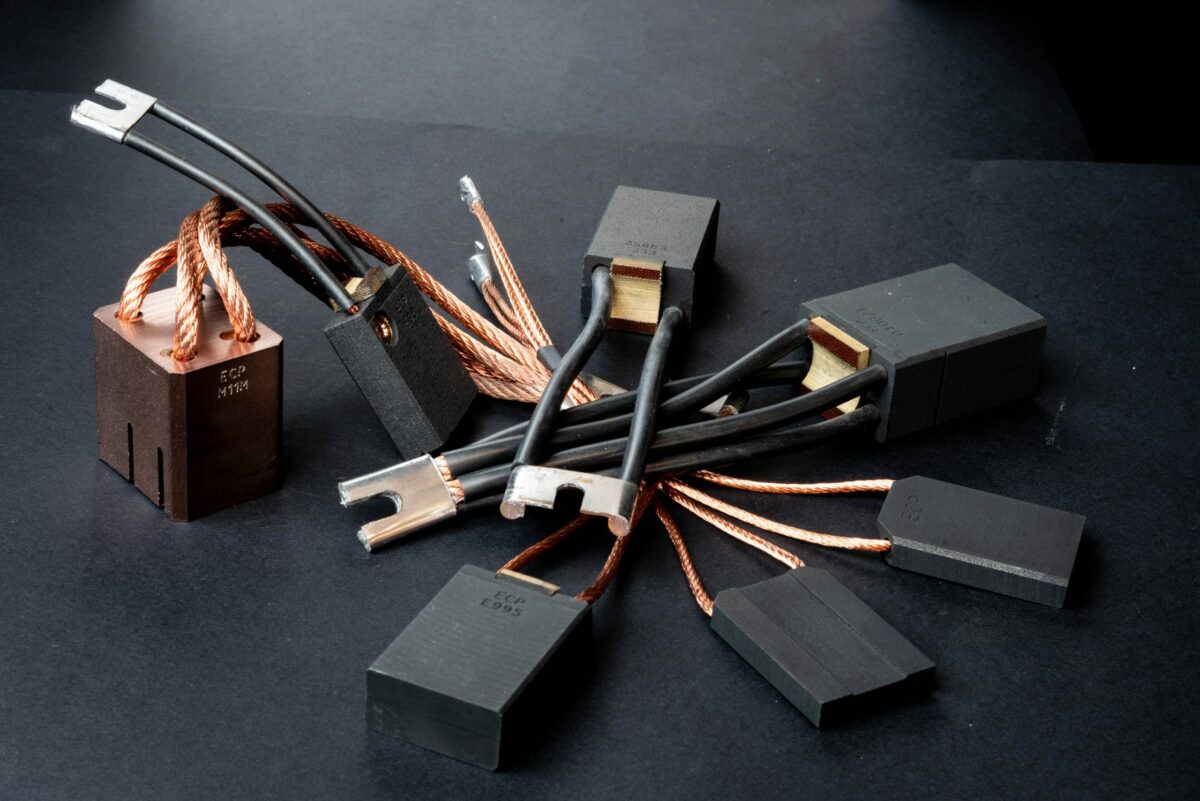
The structure of a carbon brush can vary depending on its intended application. In general, a basic carbon brush consists of a carbon block, a metal shunt, and a connection terminal. The carbon block is the primary contact surface, responsible for conducting electricity and transferring it to the machinery’s rotating part.

1.2 Working Principle

The fundamental principle behind industrial carbon brushes lies in their ability to establish and maintain electrical contact with the rotating part of a machine, such as a rotor or commutator in an electric motor. As the machine operates, the carbon brush slides against the rotating surface, creating a conductive path for the electrical current.

The friction between the carbon brush and the rotating component is carefully balanced to ensure effective electrical contact without causing excessive wear. This delicate equilibrium is crucial for the longevity and efficiency of both the brush and the machinery it serves.


II. Applications of Industrial Carbon Brushes

2.1 Electric Motors

One of the primary applications of industrial carbon brushes is in electric motors. In DC (direct current) motors, carbon brushes are essential components that transfer electrical energy from the stationary part (stator) to the rotating part (rotor). The brushes maintain continuous contact with the commutator, ensuring a constant current flow and enabling the motor to operate smoothly.

In AC (alternating current) motors, carbon brushes are less common because the design often uses other methods to transfer electrical energy. However, in certain specialised applications, such as high-performance AC motors, carbon brushes may still be employed to achieve optimal performance.

2.2 Generators

Industrial carbon brushes also play a critical role in generators, where they function similarly to their role in electric motors. The brushes maintain contact with the rotating part of the generator, allowing the conversion of mechanical energy into electrical energy. This process is fundamental to the generation of electricity in power plants and various industrial settings.

2.3 Wind Turbines

As the demand for renewable energy sources grows, so does the importance of industrial carbon brushes in wind turbines. These brushes are used in the turbine’s generator system to ensure efficient power generation from the wind’s kinetic energy. The reliability and longevity of carbon brushes are particularly crucial in this application, given the often remote and challenging environments where wind turbines are installed.

2.4 Industrial Machinery

Beyond electric motors and generators, industrial carbon brushes find applications in a wide range of machinery, including conveyor systems, cranes, and power tools. Their ability to provide a reliable electrical connection in rotating systems makes them indispensable in scenarios where electrical energy needs to be transmitted to moving components.


III. Factors Influencing the Performance of Industrial Carbon Brushes

Factors Influencing the Performance of Industrial Carbon Brushes

3.1 Material Selection

The choice of materials for manufacturing industrial carbon brushes significantly influences their performance and longevity. Different grades of carbon, along with additives such as metal powders and binders, are used. They are carefully selected based on the specific requirements of the application. The goal is to achieve a balance between electrical conductivity, wear resistance, and mechanical strength.

3.2 Brush Design

The design of carbon brushes varies based on the type of machinery and its operating conditions. Factors such as brush size, shape, and the arrangement of carbon blocks can impact the brush’s ability to maintain effective electrical contact. Engineers and manufacturers carefully design carbon brushes to ensure optimal performance while minimising wear and friction.

3.3 Operating Conditions

The operating conditions of a particular application significantly affect the performance of industrial carbon brushes. Factors such as temperature, humidity, and the presence of contaminants can influence the wear rate and electrical conductivity of the brushes. In extreme environments. Specialised carbon brushes with enhanced resistance to harsh conditions may be required.


IV. Advancements in Industrial Carbon Brush Technology

Advancements in Industrial Carbon Brush Technology

4.1 Advanced Materials

Recent advancements in material science have led to the development of high-performance carbon brush materials. Carbon composites, carbon-graphite blends, and hybrid materials incorporating metal nanoparticles are examples of innovations aimed at improving conductivity, wear resistance, and overall brush performance. These advanced materials contribute to longer service life and increased efficiency in various industrial applications.

4.2 Smart Carbon Brushes

The integration of sensor technologies into industrial carbon brushes is an emerging trend that holds the potential to revolutionise predictive maintenance strategies. Smart carbon brushes equipped with sensors can provide real-time data on factors such as brush wear, temperature, and vibration. This data allows for proactive maintenance, reducing downtime and optimising the lifespan of both the brushes and the machinery they serve.

4.3 Sustainable Carbon Brushes

In response to the growing emphasis on sustainability. There is a rising interest in developing carbon brushes with reduced environmental impact. Manufacturers are exploring eco-friendly materials and production processes. Aiming to create brushes that are not only efficient but also environmentally responsible. This shift aligns with broader industry trends toward sustainable and responsible manufacturing practices.


V. Challenges and Future Outlook

5.1 Challenges in Carbon Brush Technology

Despite their critical role in industrial machinery, carbon brushes are not without challenges. Wear and tear over time, and the need for periodic replacement. The potential for brush sparking is an issue that engineers and researchers continually address. Finding solutions to these challenges involves a combination of material advancements, innovative design approaches, and ongoing research into the optimal operating conditions for carbon brushes.

5.2 Future Developments

Looking ahead, the future of industrial carbon brushes is likely to involve further integration of digital technologies. This will involve continued material advancements and a focus on sustainability. The ongoing quest for longer service life, improved performance, and reduced environmental impact will drive innovation in this field. Additionally, collaborations among researchers, manufacturers, and end users will play a crucial role. This role will shape the next generation of carbon brush technology.

In conclusion, industrial carbon brushes are unassuming yet indispensable components that power a wide array of machinery essential to our daily lives. They power everything from electric motors and generators to wind turbines and industrial machinery. The reliable transmission of electrical energy relies on the efficiency and durability of these small yet crucial components as technology advances and industries evolve. Research and development in industrial carbon brushes continue to pave the way for more efficient, sustainable, and technologically advanced solutions by delving into the intricacies of their composition, working principles, applications, influencing factors, and recent advancements. This comprehensive guide aims to provide you with the knowledge needed to navigate the fascinating world of industrial carbon brushes.
Catégories
Non classé

Carbon Brushes: Composition and Function


Comprendre la composition et la fonction des balais de carbone par Erodex


Carbon brushes play a pivotal role in the smooth operation of various electrical machines, serving as critical components that facilitate the transfer of electrical current between stationary and rotating parts. In this article, we will delve into the composition and function of carbon brushes, shedding light on their crucial role in ensuring the efficiency and longevity of electrical systems.

Composition des brosses en carbone :

Carbon brushes are primarily composed of carbon and other materials carefully chosen to meet specific performance requirements. The main component, carbon, is selected for its unique properties, which make it an ideal material for electrical contact applications. The carbon used in brushes is typically graphite, which offers low electrical resistance, excellent conductivity, and self-lubricating properties.


To enhance the performance of carbon brushes, manufacturers often incorporate other materials into the composition. Metals such as copper, silver, or alloys may be added to improve conductivity and heat dissipation. Additionally, binders and fillers are used to give the brushes mechanical strength and stability. The careful balance of these elements results in a carbon brush with optimal electrical and mechanical properties.


Fonction des balais de carbone :

The primary function of carbon brushes is to establish and maintain electrical contact between the stationary and rotating parts of electrical machines, such as motors and generators. As electrical current flows through the brushes, it is transmitted to the rotating component, thereby converting electrical energy into mechanical motion. Conversely, in generators, the brushes collect the electrical energy generated by the machine’s rotation.


L'un des aspects essentiels des balais de carbone est leur capacité à résister aux conditions exigeantes qui règnent dans les machines électriques. Ces balais fonctionnent dans des environnements où les températures sont élevées, les charges variables et les atmosphères parfois agressives. La composition des balais doit être adaptée pour supporter ces conditions tout en maintenant des performances constantes.


Usure et déchirure :

Les balais de carbone sont sujets à l'usure en cours de fonctionnement, conséquence naturelle de la friction et du contact électrique qu'ils facilitent. Le taux d'usure dépend de facteurs tels que la charge, la vitesse et l'environnement dans lequel les balais fonctionnent. Pour y remédier, les fabricants conçoivent des balais présentant des caractéristiques d'usure spécifiques, ce qui garantit une durée de vie prévisible et minimise le risque de défaillances inattendues.


L'entretien régulier, y compris le contrôle de l'usure des balais et leur remplacement si nécessaire, est essentiel au bon fonctionnement des machines électriques. Négliger cet aspect peut entraîner une augmentation de la résistance électrique, une réduction de l'efficacité, voire une détérioration des composants de la machine.


Choisir la bonne brosse en carbone :

Selecting the appropriate carbon brush for a specific application requires careful consideration of various factors. Electrical engineers and maintenance professionals must assess the machine’s operating conditions, including voltage, current, speed, and environmental factors. Additionally, understanding the requirements for brush life and performance is essential to choosing the right brush composition and design.

In conclusion, carbon brushes are integral components in the functionality of electrical machines, ensuring the efficient transfer of electrical energy between stationary and rotating parts. Their composition, predominantly carbon with carefully selected additives, gives them the electrical and mechanical properties necessary for optimal performance. Regular maintenance and a thoughtful selection process are key to maximising the lifespan and reliability of carbon brushes, ultimately contributing to the longevity and efficiency of electrical systems. As technology advances, the evolution of carbon brush materials and designs will continue, further enhancing their performance in a wide range of applications.

Catégories
Non classé

Découpage par électroérosion à fil : Fonctionnement et applications

Découpage par électroérosion à fil : Fonctionnement et applications

Introduction


In the ever-evolving landscape of modern manufacturing, precision and efficiency are paramount. As industries demand higher tolerances and intricate designs, traditional machining methods often fall short. This is where Wire Electrical Discharge Machining (EDM) steps in as a revolutionary process, offering unparalleled precision and versatility. In this comprehensive article, we will delve into the intricacies of Wire EDM cutting, exploring its principles, mechanics, and a myriad of applications that make it an indispensable tool in the manufacturing arsenal.


Comprendre les bases


Wire EDM, also known as wire-cut EDM, wire cutting, or just EDM, is a non-traditional machining process that uses a thin, electrically charged wire to precisely cut through conductive materials. The method is based on the principles of electrical discharge machining, a process that utilises electrical sparks to erode material.


1. La mise en place


The core of a Wire EDM machine consists of a workpiece, typically made of metals like aluminium, steel, or titanium, and a spool of electrically conductive wire, usually made of brass or coated with a thin layer of brass. The workpiece and wire are submerged in a dielectric fluid, often deionised water, to facilitate the process and flush away debris.


2. Décharge électrique


The wire is systematically fed through the workpiece, guided by computer numerical control (CNC) systems. When the wire approaches the workpiece, an electric potential difference is applied, causing sparks (electrical discharges) to form between the wire and the workpiece. These sparks generate intense heat, melting and vaporising material in their path.


3. Enlèvement de matériaux


As the material is vaporised, the wire continues its path, leaving a narrow cut, or kerf, in the workpiece. The precision of Wire EDM is unparalleled, with kerf widths as small as 0.02 mm possible. This method allows for intricate shapes and fine details that traditional machining processes struggle to achieve.

Mécanique de l'électroérosion à fil


Pour apprécier pleinement les capacités de la découpe par électroérosion à fil, il est essentiel de comprendre les mécanismes qui régissent le processus.


1. L'érosion thermique


The key to Wire EDM lies in controlled thermal erosion. The intense heat generated during the electrical discharges causes the material to reach its melting point, after which it subsequently vaporises. Unlike traditional machining, where physical forces remove material, Wire EDM relies on the thermal energy of sparks to achieve the desired results.


2. Précision CNC


The precision of Wire EDM is largely attributed to the integration of Computer Numerical Control (CNC) systems. These systems guide the wire with meticulous accuracy, ensuring that the desired pattern is followed with minimal deviation. CNC programming enables complex designs to be replicated consistently, making Wire EDM ideal for applications requiring high precision.


Applications de l'électroérosion à fil


1. Industrie aérospatiale


The aerospace industry demands components with exceptional precision and durability. Wire EDM’s ability to cut through tough materials like titanium and nickel alloys with minimal heat-affected zones makes it indispensable for manufacturing critical aerospace components, such as turbine blades, engine components, and intricate parts for spacecraft.


2. Fabrication de dispositifs médicaux


In the field of medical device manufacturing, where precision is a matter of life and death, Wire EDM shines. The process is commonly used to produce intricate components for medical devices, including surgical instruments, orthopaedic implants, and components for diagnostic equipment. The fine detail achievable with Wire EDM ensures that medical devices meet stringent quality standards.


3. Secteur automobile


In the automotive industry, where the push for lightweight materials and intricate designs is constant, Wire EDM plays a vital role. From producing precision gears and transmission components to crafting complex moulds for plastic injection moulding, Wire EDM offers the accuracy and repeatability required to meet the stringent standards of automotive manufacturing.


4. Électronique et microélectronique


Les dimensions toujours plus réduites des composants électroniques exigent des procédés de fabrication capables de suivre le rythme. La capacité de l'électroérosion à fil à découper des formes complexes avec une précision de l'ordre du micron en fait un choix idéal pour la production de petites pièces complexes utilisées dans l'électronique et la microélectronique. Des connecteurs aux capteurs, l'électroérosion à fil permet de produire des composants qui répondent aux normes élevées des appareils électroniques modernes.


5. Fabrication d'outils et de matrices


Tool and die making is a cornerstone of manufacturing across various industries. Wire EDM’s ability to cut complex shapes, sharp angles, and intricate contours makes it a preferred method for producing moulds, dies, and tooling. The process’s precision ensures that the manufactured tools meet the required specifications, resulting in higher quality and efficiency in production processes.


6. Prototypage et production en petites séries


La polyvalence de l'électroérosion à fil s'étend au prototypage et à la production de petites séries. La capacité de produire rapidement et avec précision des prototypes permet aux fabricants de tester et d'affiner les conceptions avant de s'engager dans une production à grande échelle. En outre, pour les petites séries, l'électroérosion à fil offre une solution rentable avec un temps d'installation minimal.


Avantages de l'électroérosion à fil


1. Haute précision


Wire EDM’s primary advantage lies in its unmatched precision. The process can achieve tolerances in the range of micrometres, ensuring that components consistently meet exact specifications.


2. Un minimum de déchets matériels


Unlike traditional machining methods that remove material through physical forces, Wire EDM’s thermal erosion minimises material waste. The process is highly efficient, making it a cost-effective choice for applications where materials are expensive or scarce.


3. Géométrie complexe


Wire EDM excels in cutting complex geometries that would be challenging or impossible to achieve with traditional machining methods. The process allows for the creation of intricate shapes and fine details with ease.


4. Zone affectée par la chaleur minimale


Since Wire EDM relies on thermal erosion rather than physical forces, the heat-affected zone (HAZ) is minimal. This is crucial for materials with sensitive properties or for applications that require tight tolerances.


5. La polyvalence


L'électroérosion à fil est polyvalente et peut être appliquée à une large gamme de matériaux, y compris les métaux et les alliages conducteurs. Cette polyvalence lui permet de s'adapter à diverses industries et applications.


Défis et considérations


While Wire EDM offers numerous advantages, it is essential to consider the challenges associated with the process.


1. Conductivité des matériaux


L'électroérosion à fil est plus efficace sur les matériaux conducteurs. Les matériaux non conducteurs, tels que les céramiques ou certains composites, ne conviennent pas à ce procédé. Les fabricants doivent tenir compte des propriétés des matériaux lorsqu'ils choisissent la méthode d'usinage appropriée.


2. Finition de la surface


La finition de surface obtenue avec l'électroérosion à fil est généralement excellente, mais certains facteurs, tels que le type de fluide diélectrique utilisé et l'état du fil, peuvent influencer le résultat final. Un post-traitement peut être nécessaire pour obtenir des états de surface spécifiques.


3. Rupture de fil


Wire breakage is a potential issue in Wire EDM. Factors such as wire tension, electrical discharge conditions, and workpiece geometry can contribute to wire breakage. Proper machine setup and maintenance are crucial to minimising risk.


4. Considérations sur les coûts


Si l'électroérosion à fil offre une grande précision, elle n'est pas toujours l'option la plus rentable pour toutes les applications. Les fabricants doivent prendre en compte des facteurs tels que le coût des matériaux, le volume de production et le temps de préparation pour déterminer la méthode d'usinage la plus adaptée à un projet donné.


Conclusion


Wire EDM cutting has emerged as a cornerstone technology in modern manufacturing, offering unparalleled precision and versatility. Its applications span industries that demand intricate designs and high tolerances, from aerospace to medical device manufacturing. The method’s reliance on thermal erosion, guided by advanced CNC systems, sets it apart from traditional machining methods, opening up new possibilities for engineers and designers.


As technology continues to advance, Wire EDM is likely to evolve further, pushing the boundaries of what is achievable in precision and efficiency as manufacturers strive to meet the ever-increasing demands for complex components and streamlined production processes. Wire EDM stands as a testament to innovation in machining.